


Every buyout begins as a short list of numbers: how fast revenue grows, how far margin moves, what the asset fetches at exit, how much debt it carries. We call those the load-bearing variables, and we define one as a quantity the entry price depends on so tightly that a 10 percent miss on it moves the underwritten exit value by more than 10 percent. The deal team measures them carefully exactly once, in diligence.
To see what happens to them afterwards we read 14 IPO prospectuses of companies a private investment firm controlled at listing, the fiscal 2025 annual reports of 4 listed sponsors, and the published attribution of buyout value creation. The 14 are BrightSpring, Waystar, Ingram Micro, StandardAero, Loar, Lineage, Ardent Health, SailPoint, Karman, McGraw Hill, NIQ, Legence, Medline and Accelerant. The thesis is plain: an investment thesis survives ownership only if its 3 or 4 load-bearing variables are re-measured after close, on the definitions used at underwriting. Most stop being tested the day the 100-day plan starts, because the scoreboard switches to adjusted EBITDA.
The deal team writes the plan, and the clock it has to survive is long
Sponsors say plainly where the plan is authored. Carlyle's annual report describes a systematic value creation plan developed during a thorough due diligence effort, and the firm retains approximately 45 operating executives and advisors as independent consultants to work alongside its investment teams. The plan is a diligence product, handed across at close to people who were not in the data room when its numbers were set.
The clock it has to survive is long. The median holding period for buyout-backed exits was 6.6 years in 2023 and 6.5 in 2024, against 4.1 in 2005. In our own sample, the 8 prospectuses that date the sponsor's entry, SailPoint, Ingram Micro, McGraw Hill, Medline, NIQ, BrightSpring, StandardAero and Ardent Health, put holds between 2.5 and 9.0 years, with a median of about 4 years. A thesis written in a data room has to hold up across several years of an economy nobody underwrote.
The capability waiting on the other side is institutional and expensive. KKR disclosed fees attributable to KKR Capstone of $113.6 million in fiscal 2025, and Blackstone's private equity segment runs on approximately 720 employees. What is thin is not the staffing. It is the link between what those teams report each month and the 3 or 4 numbers that set the price.
2 variables an owner can move carry almost all of the gain
Which variables carry a buyout return is a measured question rather than a matter of taste. StepStone decomposes the unlevered value created across 909 buyout deals done since January 2015, each at least 80 percent realized, in which 1.00x of invested capital becomes a 2.18x unlevered gross multiple. Of that 1.18x of gain, revenue growth accounts for 0.86x and margin expansion for 0.24x.
The bars an owner does not control net to very little. Market multiple expansion adds 0.48x while manager-specific multiple expansion takes 0.14x back, and debt paydown net of dividends takes 0.27x out of the gain. So 93 percent of the gain comes from 2 variables a management team can move, the multiple contributes 29 percent net, and the capital structure takes 23 percent back.
This is not the finding of a single paper. An earlier StepStone analysis, published in March 2017 on 1,533 realized deals and on a levered base, put 56 percent of value creation in market leverage; on our own rebasing of its non-leverage components, an approximation of the later unlevered base rather than the same definition, the operating share is 80 percent. The 2017 paper states no period, so these are 2 readings of a single question and not a change over time.
The return itself is not a test of the thesis. StepStone makes the point with a worked illustration of its own: 2 model managers at the same 2.5x, one taking about 43 percent of its value from EBITDA growth and the other 7 percent, with 80 percent from leverage. Identical outcome, opposite causes. Only the decomposition tells an owner which of its load-bearing variables actually performed.

Across 909 realized buyouts done since 2015, revenue growth and margin carried 1.10x of the 1.18x unlevered gain; the multiple contributed 0.34x net and the capital structure took 0.27x back.
Source: StepStone Group, Are Private Equity Valuations Too High?, April 2023, Figure 4 (StepStone Private Markets Intelligence as of 31 December 2022; pooled and normalised to 1.00x of invested capital); Lunon analysis for the shares of the gain.
After close the scoreboard becomes adjusted EBITDA
A sponsor-backed IPO prospectus is the one public document in which an owner narrates a whole ownership period and chooses which quantities to put numbers against. Across every Form 424B4 prospectus filed with the SEC in 2024 and 2025, 1,101 documents, adjusted EBITDA appears in 146, "100-day plan" in 1 and "first 100 days" in 1. Read rather than counted, the 2 hits are a proxy campaign at a listed company and a teacher onboarding programme, so 0 of 1,101 use either phrase for a plan written at acquisition.
Our 14 sponsor-controlled issuers read the same way from the inside. 13 of 14 keep score on adjusted EBITDA, all but SailPoint, which reports annual recurring revenue and a net retention rate instead. The post-close plan itself is named as a value creation plan in 1 of 14, NIQ, and the first 100 days in none of them.
The swap is visible in a single section heading. A Carlyle-owned aerospace company gives its prospectus a section headed Key Performance Indicators and Non-GAAP Financial Measures, and the only 2 non-GAAP measures it puts forward there are adjusted EBITDA and adjusted EBITDA margin. Margin survives the swap in that form. Revenue growth, the exit multiple and net debt do not.
A prospectus measures what an owner will stand behind publicly, not what it read internally, and that is the honest limit of the count. It is also the nearest public evidence of what an ownership period was kept score on, chosen by the owner itself after years of holding the asset and with every incentive to show the measures that flattered the hold.
The measurement cadence drops at the close and never recovers
The industry measures its own drop. In AlixPartners' survey of private equity leaders, 68 percent of firms assess a portfolio company's executive team regularly and formally during diligence, 55 percent in the first 100 days and 54 percent through the rest of the hold. Formal assessment stays the most common answer at every stage. What goes is the step change at signing, a fall AlixPartners calls a fifth that never recovers.
The bill arrives in year 2. 65 percent of firms report CEO turnover during the holding period, 45 percent of it between the first and second year, and 92 percent of unplanned departures are the firm's own decision. Year 2 is when the first 2 performance cycles have been read and the plan has not held, which is a late moment to discover that a load-bearing variable was never measured again.
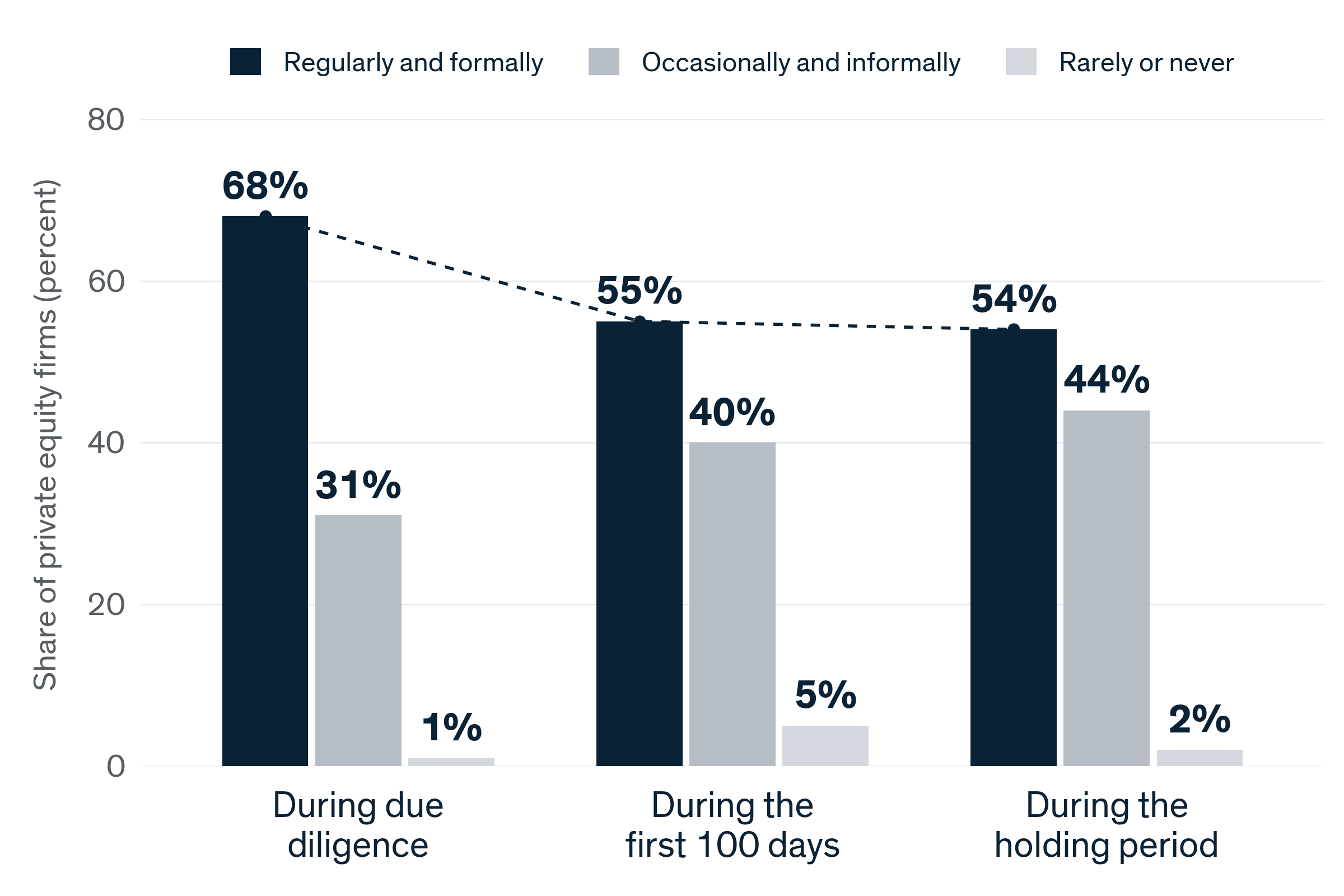
68 percent of private equity firms assess a portfolio company's executive team regularly and formally during diligence, and a fifth of that falls away at the close: 55 percent in the first 100 days and 54 percent through the rest of the hold. Source: AlixPartners, Eleventh Annual Private Equity Leadership Survey, 2026 (174 private equity managing directors, operating partners or founders and 253 portfolio company executives, surveyed October to December 2025).
Re-measurement means the same definition, not a new metric
Re-measurement is narrower than reporting. It is the same quantity, on the same definition and the same population, computed again after close and set beside the underwriting figure. A new metric with a new definition is not a re-measurement, it is a replacement, and replacements are what the public record mostly shows.
Customer retention is the clearest case of the drift. 7 of our 14 issuers put a number against it, and each defines the measure itself: Accelerant on insurance written premium, Legence on project revenue and across 3 years at once, McGraw Hill on invoiced digital subscriptions, SailPoint on annual recurring revenue, Medline on Prime Vendor net sales, with Waystar and NIQ on bases of their own. At least 5 bases, so the 7 numbers cannot be set beside one another, and retention is a route to the revenue variable rather than a load-bearing variable itself.
The discipline is possible, and 2 of the 14 prospectuses show it being done, McGraw Hill and BrightSpring. McGraw Hill publishes a 3 year series on the operating metrics management says it monitors: re-occurring revenue at 69, 67 and 63 percent of total revenue, and annual net dollar retention of 110, 110 and 106 percent in higher education. The prospectus also states which segments the retention measure covers, 44 percent of revenue, which is what makes it a definition rather than a headline.
BrightSpring goes further, reporting on all 57 businesses it had bought since 2018: 55 of them were more profitable than when it bought them, and post-close growth had cut the aggregate purchase multiple by about half. Those are 2 separate disclosures, and both set the trailing 12 months at each acquisition date against one fixed later window. It is the closest thing in the public record to a deal team's own arithmetic, re-read years later.
4 variables, 1 definition each, written down before the handover
The useful version of this is short, and none of its 4 parts is a new metric.
Revenue growth carries most of the gain. It is 0.86x of the 1.18x and the variable the underwriting case leans on hardest. Re-measure it on the same volume and price split, across the same customer population the underwriting case used.
Margin is the second operating variable. Margin expansion adds 0.24x of the gain. Re-measure it on the underwriting bridge rather than on the adjusted EBITDA reconciliation that replaced it, because the add-backs are where the 2 definitions part company.
The exit multiple belongs to someone else. Market multiple expansion added 0.48x and manager-specific expansion took 0.14x back, so the multiple is a variable to track against the underwriting assumption, never one to claim as progress.
Net debt is a decision, not a result. Debt paydown net of dividends took 0.27x out of the gain in the same population. Read the financing line against the case that was underwritten, and record which part of the move was a choice the owner made.
The test of a thesis is whether anyone has looked again
The test of a thesis is not whether the company hit its EBITDA. It is whether the 3 or 4 numbers that justified the price still read the way they did in the data room, and whether anyone has gone back to check. In 2024 privately held portfolio companies grew revenue and EBITDA at roughly the same rate as public companies, which is precisely the year in which knowing your own load-bearing variables separates owners from passengers.
That is a decision the deal team makes before the handover and not a reporting preference the operating team inherits. Name the 3 or 4 variables in the investment committee memo, fix a definition for each, and hand both across with the plan. The hold is long and the exit is priced by a market nobody controls, so the only part of the thesis an owner can test is the part it agreed to keep measuring.


Start with the decision in front of you.
Tell us what your team needs to understand, evaluate, or deliver.